Ir al contenido principal

Author: vanessa

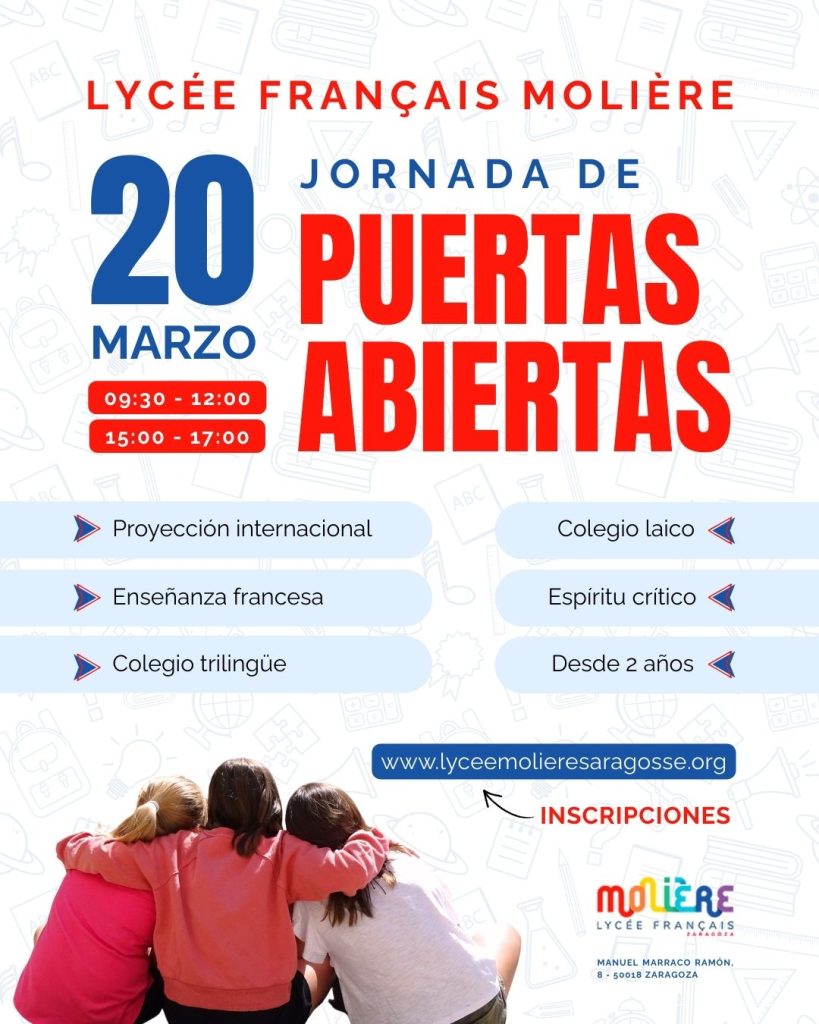
Molière-20-march-open-doors-open

When is the open day at the Lycée français Molière?

The 20 March, the Lycée français Molière opens its doors to welcome families interested in learning more about our educational project. The day will be held in two shifts: from 09:30 a 12:00 and 15:00 a 17:00. In this way we offer the opportunity to get to know our educational project while touring our facilities to discover how we accompany our pupils from the age of 2 to university.

Trilingual French school in Zaragoza

In the Lycée français Molière we offer an education with international projection where students develop critical thinking, autonomy and intellectual curiosity. Our educational model is trilingual, The programme is a combination of French, Spanish and English, and prepares students to function fluently in multicultural and academic contexts around the world.

Secular education and integral education

Our centre is based on the values of secular and inclusive education, by fostering a respectful and stimulating environment. From infancy to pre-university, we accompany each student in their academic, social and personal development, ensuring that they acquire solid skills and a well-rounded education.

School services for families

In addition to academic education, we offer services that make it easier to reconcile family and childcare, such as our childcare service or canteen.

Why attend an open day

During the day you will be able to:

  • Knowing our educational project and international focus.
  • To go through the facilities of our centre.
  • Resolving doubts directly with the teaching staff.
  • To know first-hand what your children's day-to-day life will be like.

This visit is the ideal opportunity to discover how our school combines academic excellence, comprehensive education and a close family environment.

Registration for the open day

Participation in the conference requires prior registration. You can register quickly and easily here.

In the Lycée français Molière, We are committed to an education that prepares students for a global future, promoting values, autonomy and multilingual learning from the earliest years. We look forward to seeing you on 20 March to discover our school and all that we can offer your family.

change-a-trilingual-school

Joining a trilingual school: Doubts and challenges

If your children have always studied in a traditional school and you have decided to make the step towards a trilingual school, It is normal for doubts and worries about their future to arise. A change of environment in this case involves new languages, new methodologies and different routines, and many families wonder what the future will be like. academic adjustment, The social and emotional development of their children. In the Lycée Français Molière, international trilingual school in Zaragoza, We accompany families and students so that this process is calm, positive and enriching from the very first day. Today we discuss some of the most frequently asked questions:

Will my son or daughter be able to keep up academically even if he or she does not have a high level of French or English when he or she arrives?

One of the most common fears is that pupils will not master the school languages perfectly and will fall behind. In order to facilitate the linguistic and academic integration, In our school we carry out various actions and initiatives such as:

  • Use of visual resources, games and interactive materials that allow participation from day one.
  • Offering practical projects where students gradually apply what they have learnt.
  • Individual support and reinforcement according to the needs of each student.
  • Progress monitoring to build their confidence and security as they adapt.

In this way, students can keeping up with the pace of the classes while developing language and academic skills without pressure.

How will they adapt socially to a new environment with new peers, values and spaces?

Joining a new group and adapting to different routines can be a source of uncertainty for both pupils and families. In order for the social adaptation is positive we promote:

  • Welcome activities and group dynamics for students to get to know each other at the beginning of the course.
  • Individualised tutoring that favours emotional and social adaptation.
  • Games and collaborative projects that encourage cooperation, respect and empathy.
  • Spaces for each child to find his or her place in the community and feel safe.

Through these actions, students build relationships and feel part of the school from day one while developing key social skills.

Will you be able to follow the academic progress of the trilingual school without losing previous learning?

Another common concern is that the change will affect what was learned in the previous school. To ensure a smooth transition:

  • We assess each student's level at the beginning to identify strengths and areas to be reinforced.
  • We adapt the activities and projects according to your needs and learning pace.
  • We combine academic continuity with the progressive introduction of new methodologies.
  • We monitor progress in all subjects so that students make progress without feeling overburdened.

In this way, pupils reinforce what they already know and become familiar with trilingual learning gradually and without losing motivation.

As you have already seen, changing to a trilingual school can generate doubts, but with close accompaniment, progressive adaptation and personalised attention, students manage to integrate little by little while including the language in their daily lives. learning in French, English and Spanish.

In the Lycée Français Molière we are available for answer any questions you may have and accompany you throughout the whole process. Our aim is for each family to feel at ease in the knowledge that students will receive the support they need to grow academically, socially and emotionally as they discover the opportunities that an international environment offers.

international-school

Why more and more families are choosing an international school for their children

In the Lycée Français Molière we know that choosing a school is an important decision. More and more families are looking for an education that combines languages, values and real-life experiences to prepare students for a global (and very demanding) world. Our aim is for students to grow up feeling confident, autonomous and with a broad vision of the world from an early age, enjoying learning and feeling accompanied every step of the way. In this article we group together some of the reasons why families choose to trust in an international school such as the Lycée français Molière.

Learning based on trilingual education at all stages of education

Languages are the common thread running through everything that happens on a day-to-day basis in any international school and this may be the number one reason that motivates families. For us, learning languages means being able to communicate with confidence, understand other cultures and learn to adapt to different environments. That is why our school integrates French, English and Spanish in everyday life, from Pre-school to Baccalaureate, ensuring that each educational stage reinforces their linguistic and academic skills.

The trilingual education enables students to develop strong communication skills and confidence to express themselves in any situation. In addition, we follow international standards so that they can continue their studies both in Spain and abroad with a solid foundation in language and academic skills.

International experiences and continuous learning-by-doing

Language goes beyond the classroom. We love students to have international experiences that complement what they learn on a day-to-day basis. We organise projects with schools in other countries, exchange and mobility programmes as well as educational trips that allow you to get to know new cultures and ways of learning.

These experiences foster autonomy, responsibility and critical thinking. We want students to learn to solve problems, adapt to different situations and work in teams with people from different backgrounds, enjoying every moment and connecting what they learn with real life.

Values and academic culture combined with personalised accompaniment

Teaching students from the idea of reinforcing their personal development is key in international schools like ours. We work so that each student feels accompanied and valued, we get involved in their personal development and we offer close monitoring and individual attention to help families see how their children are progressing and developing in all areas.

Our educational project is based on values such as cooperation, responsibility and respect for diversity. By combining international education, practical experience and personalised support, we ensure that students acquire the security, autonomy and confidence to face their future.

In short, choosing a school is about more than academic excellence, it is about finding a place where students feel supported, motivated and prepared for any challenge. At Lycée Français Molière (School in Zaragoza) we are available to answer any questions you may have and to help families in any way we can. Do not hesitate to contact us for more information or to arrange a visit.

international-mobility

The benefits of international experiences for students at the Lycée Français Molière

Let's face it, who doesn't like to travel and be with friends? What if you could combine both while learning and discovering the world in a real and accompanied way? That's exactly what we at the Lycée Français Molière achieve with our international mobility experiences for students. It's all advantages!

Benefits of international education for students

As we always say, in the Lycée Français Molière We believe that learning languages and academic content is very important, but it is not enough on its own. The real international experiences help our students to using what they learn in class in real-life contexts, They are able to communicate fluently outside school and understand other cultures in depth. This gives them a real advantage in today's world, and prepares them to be global citizens with critical thinking and autonomy. Some of the skills or advantages that our students acquire are the following:

Language skills and confidence in speaking

Study three languages in the classroom is a great foundation. But when students travel or participate in international projects, The students use French, English and Spanish as communication tools in everyday situations. This improves fluency, comprehension and confidence when speaking in contexts outside of school, something no book can fully replicate.

Personal development and autonomy

Exchange stays, mobility or activities away from home require students to make decisions, organise themselves and deal with minor difficulties. These experiences help them to gain self-confidence and autonomy, These competences will serve them both in their educational stage and in any future stage of their lives.

Cultural understanding and global mindset

When pupils live with peers from other countries or participate in joint projects with other schools they understand ways of thinking different from their own and learn to respect diverse perspectives. These situations give them a global mindset and teach them to communicate with respect for other cultures.

International experiences in our educational project

At Molière, international experiences are not isolated. They are frequent, they are part of the educational trajectory of each student and are integrated at different stages of development. From outings to nearby areas for a few days for the youngest children to more extensive mobility programmes in different countries and continents for weeks at a time.

  • We offer exchanges and educational stays with partner centres in France and other countries where students can live with local families and continue learning outside their usual environment.
  • We organise collaborative projects and international activities which complement what is learnt in class, reinforcing motivation for languages and cooperation between classmates.

These elements form a continuum of experiences that makes the learning in the classroom have a direct impact on students' real lives.

Global skills that develop international experiences

International experiences go beyond language proficiency and, as mentioned earlier, help students to acquire skills that universities and the professional world are increasingly valuing.. We can see some examples:

  • Professional and cultural communication in several languages.
  • Adaptation to new situations and problem solving.
  • Empathy and respect for human diversity.
  • Confidence to face personal and academic challenges.
  • Ability to work with people from different backgrounds and cultures.

These skills are not only useful for the present but also for the future. accompany the student throughout his or her life preparing you for academic and employment opportunities both in Spain and abroad.

Why the international vocation is part of the Lycée français Molière's identity

To be the the only trilingual international school in Aragon gives us a clear responsibility: to offer our students an education that is not limited to the classroom, but which include experiences that broaden your horizon. Again, international education is a key part of our identity because it allows what is learnt in the classroom be used to understand the real world, make meaningful human connections and grow as a person..

From the Lycée Français Molière we accompany every step of your child's development with experiences that strengthen his or her ability to face a diverse, dynamic and international future. If you have any questions about our programmes and initiatives, you can contact us here.

menu-christmas-in-family

Christmas menu: Cooking with children at Christmas and enjoying with the family

Christmas is an ideal time to share time at home and bring children into the kitchen without rushing. Preparing traditional recipes together, as well as being a way of enjoying time together and gastronomy, helps to transmit culture and the value of doing things calmly and with dedication to children. At the Lycée français Molière we offer you a christmas menu to cook with your children during these next few weeks of festivities. It combines simple traditional dishes from Aragon and one from French cuisine: all of them are easy to prepare and adapted so that children can really get involved. Shall we cook?

Christmas menu for cooking with children

This menu does not pretend to be perfect or spectacular. The idea is that the kitchen becomes a shared space where each child can participate according to their age and where the process is as important as the result.

Starter: Bread with tomato and Teruel ham

A simple, tasty classic, perfect for introducing children to cooking. It is a staple for many and with a good product it is impossible to go wrong. Write down the ingredients and preparation steps:

  • Rustic or village bread
  • Ripe tomatoes
  • Extra virgin olive oil
  • Teruel Ham
  • A pinch of salt

The children can start by washing or, even if they are older, grating the tomatoes. In the meantime, slice the ham. Then spread the tomato on the bread, add a drizzle of oil and a pinch of salt, and finally put the ham on top. Finally, place the ham on top and that's it! Let's go on to the rest of the dishes on our menu.

Second starter: Cheese and vegetable quiche

Quiche is a very common recipe in French cuisine and we could not forget it on this occasion. It is a dish designed to combine ingredients and share with the family. It's easy, versatile and very suitable for cooking with children. These are the ingredients needed and how to prepare it:

  • A shortcrust pastry base
  • 3 eggs
  • 200 ml cooking cream
  • Grated soft cheese
  • Vegetables to taste, cut into small pieces
  • Salt and pepper

It is easy to prepare. Place the dough in the mould and prick it with a fork. The children can beat the eggs, add the cream, cheese and vegetables and mix everything together carefully. Pour the mixture over the base and bake in the oven until set. Watching the quiche transform in the oven is often one of the most enjoyable moments.

Main course: Roast veal from Aragon

Roast veal is one of the great traditional dishes here in Aragon and even more so at Christmas time. Of course, the key is to respect the product and not overload it with too many ingredients. This is all you need to prepare it:

  • Ternasco de Aragón
  • Potatoes
  • Garlic
  • Olive oil
  • Salt
  • Rosemary or thyme

Place the sliced potatoes on the tray forming a base, add the veal, garlic, herbs and salt to taste. The children can help to distribute the ingredients and add the oil. The oven takes care of the rest, it couldn't be easier!

Dessert: Sweet Christmas braid

We wouldn't have a good menu without dessert. And baking is always a good end to cooking with children. We propose this sweet braid recipe because it is simple and allows you to focus on the more creative part. Here are the necessary ingredients and their preparation:

  • Puff pastry dough
  • Egg
  • Sugar
  • Rolled almonds or pearl sugar
  • Sultanas

The preparation is very simple. Roll out the dough and make two vertical cuts to braid it. Then brush with egg and the children can sprinkle with sugar or add almonds. Bake at the temperature indicated on the dough package until golden brown. It doesn't matter if the shape isn't perfect - the aim is to enjoy the process!

We hope that you have enjoyed this Christmas menu and that you are encouraged to make it at home. Cooking as a family at Christmas is a simple way of sharing, learning and creating memories that will stay with children for the rest of their lives. From the school we encourage you to enjoy these days enjoying the little moments at home and to turn the kitchen into a meeting place. We wish you a Merry Christmas!